admin_suk
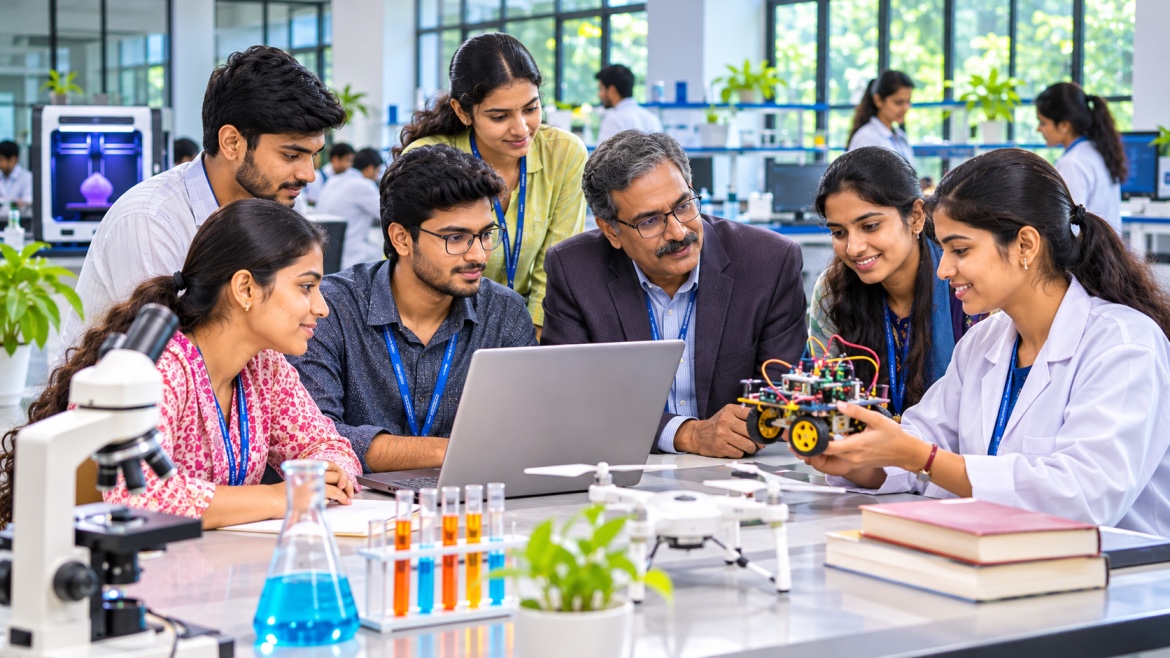
Research Opportunities at Sharnbasva University: Encouraging Innovation, Discovery and Academic Excellence
Research is one of the most important foundations of higher education. It encourages people to question existing ideas, explore new possibilities, develop solutions and contribute knowledge that can make a meaningful difference to society. Universities play a vital role in this process by creating an environment where curiosity, experimentation and innovation are encouraged.
At Sharnbasva University, Kalaburagi, research and innovation are important parts of the academic environment. The university encourages faculty members, students and research scholars to explore new ideas, undertake research projects and contribute to advancements in their respective disciplines.
With research initiatives, academic guidance, innovation activities, research collaborations and incubation support, the university provides opportunities for individuals interested in developing their research capabilities and transforming ideas into practical outcomes.
A Research-Oriented Academic Environment
Research is not limited to laboratories or doctoral programmes. It can begin with a classroom question, a student project, an observation about society or an idea that addresses an existing problem.
At Sharnbasva University, research opportunities extend across different academic disciplines, including Engineering and Technology, Computer Applications, Business Studies, Science, Social Sciences, Languages, Fine Arts, Architecture and Pharmaceutical Sciences.
This multidisciplinary approach creates opportunities to examine problems from different perspectives. For example, engineering research can contribute to technological development, scientific research can expand understanding of natural processes, and social science research can help address issues affecting communities.
The university’s Research and Innovation Council provides an institutional framework for promoting research activities and strengthening the research culture across its academic faculties.
Research Opportunities Across Different Disciplines
One of the advantages of a multidisciplinary university is the opportunity to explore research questions across a wide range of subjects.
Some potential research directions include:
Engineering and Technology: Artificial intelligence, machine learning, computer science, cybersecurity, electronics, communication systems, renewable energy, robotics and sustainable engineering.
Computer Applications: Software development, data analytics, cloud computing, mobile applications, digital technologies and information systems.
Science and Technology: Physics, chemistry, mathematics, biological sciences, environmental studies and interdisciplinary scientific research.
Business Studies: Entrepreneurship, finance, marketing, human resource management, business analytics, organisational development and emerging business models.
Social Sciences: Rural development, public administration, sociology, economics, governance, community development and social inclusion.
Languages and Fine Arts: Literature, linguistics, cultural studies, visual arts, music, creative expression and heritage preservation.
Architecture and Pharmaceutical Sciences: Sustainable architecture, urban planning, building technologies, pharmaceutical research and related scientific studies.
These areas offer starting points for students and scholars to identify research questions that match their academic interests and professional aspirations.
Government-Funded Research Projects and Research Support
Access to research support can help faculty members and research teams move beyond theoretical exploration and undertake projects with practical relevance.
Sharnbasva University’s published research information highlights opportunities to pursue projects supported by funding agencies such as the All India Council for Technical Education (AICTE), Vision Group on Science and Technology (VGST) and Karnataka State Council for Science and Technology (KSCST).
Such funding programmes can provide avenues for researchers to develop proposals, investigate important problems and work towards solutions with academic, technological or social value.
Researchers interested in external funding can benefit from identifying relevant schemes, understanding eligibility requirements, preparing project proposals and developing clear implementation plans.
Centres of Excellence: Connecting Research with Emerging Technologies
Centres of Excellence can play an important role in strengthening advanced learning, technical exposure and collaborative research.
At Sharnbasva University, the Faculty of Engineering and Technology for Women highlights Centres of Excellence and industry-associated learning initiatives in emerging technology areas.
These initiatives create opportunities to explore subjects such as:
Artificial Intelligence and Machine Learning
Internet of Things (IoT)
Data Analytics
Emerging computing technologies
Advanced technical applications
Through hands-on learning, technical activities and interdisciplinary engagement, such environments can help students and faculty members connect academic concepts with practical challenges.
Innovation and Incubation: From Ideas to Practical Solutions
Research becomes especially meaningful when ideas can be developed into solutions that address real-world needs.
Sharnbasva University’s K-Tech Innovation Hub, established under Karnataka’s New Age Innovation Network (NAIN) initiative, supports student entrepreneurship and innovation. The university also describes an MSME incubation facility as part of its innovation ecosystem.
The K-Tech Innovation Hub encourages students to identify local challenges, explore technology-based solutions, develop prototypes and receive mentoring. The university’s published information also describes support for selected proof-of-concept projects, including funding opportunities subject to the applicable selection process.
The incubation environment can help aspiring entrepreneurs understand how to develop an idea, validate its feasibility, build a prototype and explore its potential for commercial application.
For students with an interest in entrepreneurship, these opportunities can provide a valuable connection between academic learning and startup development.
Research Publications and Intellectual Property Rights
Sharing research findings is an important part of academic development. Research publications allow scholars to communicate their discoveries, contribute to existing knowledge and engage with the wider academic community.
Intellectual Property Rights (IPR) are equally important, particularly when research leads to an original invention, design, technology or creative work.
Sharnbasva University highlights an Intellectual Property Rights Cell that promotes awareness and provides guidance on intellectual property. Its published prospectus also discusses research ethics and academic integrity, including the importance of avoiding plagiarism, fabrication and falsification of research data.
For students and researchers, understanding publication practices, research ethics, citation methods, patents and intellectual property protection is an essential part of responsible research.
Collaboration and Interdisciplinary Research
Many of today’s challenges cannot be addressed through a single academic discipline. Areas such as climate change, public health, artificial intelligence, sustainable development and rural transformation often require knowledge from multiple fields.
Academic collaboration allows researchers to exchange ideas, share expertise and work towards common objectives. Industry and institutional partnerships can also provide exposure to practical challenges and help connect academic research with real-world applications.
Sharnbasva University’s Research and Innovation framework includes collaboration and Memoranda of Understanding (MoUs) as part of its broader research and academic ecosystem.
Opportunities for Students and Research Scholars
Research opportunities are valuable at different stages of an academic journey.
Undergraduate students can begin by undertaking project work, participating in technical competitions, exploring innovative ideas and working with faculty mentors.
Postgraduate students can develop deeper subject knowledge through research-based assignments, specialised projects, technical investigations and academic publications.
Ph.D. scholars can pursue advanced research under the guidance of eligible research supervisors, subject to university regulations and admission requirements.
Faculty members can explore funded research, consultancy, interdisciplinary projects, publications and participation in academic conferences.
The university’s published employee guidelines also describe research-related support for faculty, including opportunities to pursue sponsored research, consultancy projects, research seed grants and conference participation, subject to applicable institutional provisions.
Why Research Matters for the Future
Research develops more than academic knowledge. It builds critical thinking, patience, analytical ability, creativity and the confidence to investigate difficult questions.
Students who participate in research activities can gain valuable experience in problem identification, information analysis, experimentation, technical documentation and presentation of findings.
For society, research can contribute to improved technologies, better public services, sustainable practices, entrepreneurship and solutions to local and global challenges.
By encouraging research and innovation across disciplines, Sharnbasva University aims to nurture individuals who can contribute knowledge, create opportunities and address the needs of a changing world.
Begin Your Research Journey at Sharnbasva University
Whether you are an undergraduate student interested in developing an innovative project, a postgraduate learner exploring specialised research or a scholar planning doctoral studies, research offers an opportunity to move beyond established knowledge and discover new possibilities.
Sharnbasva University, Kalaburagi, encourages academic inquiry through its Research and Innovation Council, research initiatives, Centres of Excellence, innovation and incubation activities, and intellectual property awareness programmes.
Explore your ideas. Investigate meaningful questions. Develop solutions. Contribute to knowledge.
At Sharnbasva University, research is an opportunity to turn curiosity into discovery and innovation into impact.
Learn More
Explore the university’s official Research & Innovation resources, including research initiatives, innovation and incubation activities, and academic programmes:
Research and Innovation Council
Research & Innovation – Faculty of Engineering and Technology (Women)
Innovation & Incubation
Ph.D. Programmes
Visit: https://suk.edu.in/